HERITAGE, BORDER
September 2024
La Escuela Himdag Ki: Tohono O'odham Mexico
Sonora’s School Of Indigenous Cultures
Magdalena de Kino, Sonora, Mexico
The Man in the Maze coat-of-arms of the indigenous School Himdag Ki: Tohono O’odham Mexico shines in the last hues of the dying sun. It symbolizes the Tohono O’odham people’s beliefs about the journey of life from birth to death and the becoming one with I’itoi, the Creator, into the afterlife. As the shadows approach, a honey color dog will soon take a rest at the school’s doorsteps. Photo by Natasha Cortinovis
As the sun sets upon the ancient desert hills of San Isidro, SON., México, a light brown watchdog is slyly patrolling the perimeter of a small, indigenous school.
It has been over two years since Maghi decided to become the school's faithful guardian.
After scouting the area, she lays down against the white wall of the school’s main building. As Maghi’s eyelids grow heavy, the golden light strikes the circular mural above her canine body.
It reads Escuela Himdag Ki: Tohono O’odham Mexico in black uppercase letters.
The spacious yard, the sunburnt earth, a big brick fireplace, an open-air kitchen, and other undone edifices are already shrouded in shadow.
Everything, from the modest structures to the wide open spaces, suggests a life spent outdoors. Beyond the hill where the property sits, overlooking the neighborhoods of Magdalena de Kino, SON., the Sonoran Desert unfolds in gentle elevations.
La Escuela Himdag Ki:, which means our way of life in the language of the O’odham people, was not always a school, nor did it always bear this name.
Indigenous, though, it always was.
Its purpose began in 1993, when Purépecha María Angelita García, 94, and her Tohono O’odham husband, José Martin García Lewis, 81, acquired the land through the generous gift of an American man who went by the name of "Sky".
Yet, the place's soul developed between the 1980s and 1990s, when the couple was fighting for the legal recognition of the indigenous communities of the state of Sonora within the constitution of Mexico.
“With the division of the border between Mexico and the United States through the Gadsden Purchase [‘Tratado de la Mesilla’ in Spanish] in 1854, the Tohono O’odham people have been forever separated”, says María Angelita García, owner of the land in San Isidro, and of the restaurant La Indita in Tucson, AZ.
With that separation, a portion of the Tohono O’odham community fell under Mexican rule. In a testimony by Verlon Jose, the Chairman of the Tohono O’odham Nation of Arizona, it is reported that seventeen O’odham communities with approximately 2,000 members are still located in their historical homelands in Mexico.
“We are working on a census that reveals that there are more,” said the Chairman during an event called Tribal Perspectives on Borderland Issues at the Tohono O’odham Community College. “We believe there are around 6,000 O’odham in Mexico.”
It wasn’t until 2018 that the first historical O’odham Kuinta, a census of their population in Sonora, Mexico, was ever undertaken. Led by José Martin García Lewis, the four month project counted approximately 7,000 O’odham in the municipalities of Sonoita, Puerto Peñasco, Caborca and Hermosillo.
“It was possible to prove that they were O'odham through their last names,” says García in Spanish.
Although in 1988, the Tohono O’odham Nation of Arizona established an office to serve its tribal members residing in Mexico, especially in the municipalities of Caborca, Puerto Peñasco, Plutarco Elías Calles, Altar and Sáric, SON., she says, there was almost no legal evidence of these communities at that time.

José and Maria García participate in the 2018 count of the Sonoran O'odham. Shared with Natasha Cortinovis by the Garcías
“In Mexico, they were like forgotten,” says García.
Ever since the division of the border, the O’odham in Mexico have faced these serious difficulties because large landowners have continued to eat away at their lands. According to researcher Gerardo L. Cadava, by the late 1960s, U.S. and Mexican states began to see border areas as “symbols of the frontier’s capitalist development.”
“The wealthy Pesqueira family bought a lot of the lands where the O’odham lived in Mexico, without their consent, for greed,” says Denise Ixchel Schafer, 61, García’s daughter and Director of the school Himdag Ki:, and the manager of La Indita.
The plight of the O’odham people of Mexico became even more personal for the García family when these wealthy ranchers burnt her mother-in-law’s home made of ocotillo and adobe to deprive her of her land in El Bajío, in the municipality of Altar, SON.
She was O’odham and her name was Elena Teresa Lewis.
“My mother-in-law used to say that this was the whole life of the O'odham Indians, little by little they were dispossessed of their lands until they were reduced to hamlets of a maximum of 10 houses in the community of El Bajío and to one house in the community of Pozo Verde, municipality of Saric [SON.],” says García.

Remains of Elena Teresa Lewis' humble home in El Bajío, Altar [Sonora, Mexico], burnt on purpose by wealthy ranchers believed to be involved with the cartel of the region. Photo by José Martin García Lewis
From the 1980s onwards, the García family kept on visiting the O’odham people and government institutions in Sonora to seek the acknowledgment of their historical rights of territory, language and culture within the constitution.
Over time, these visits became important meetings, gathering in San Francisquito, SON., not only Tohono O’odham leaders, but also Comcaac, Yaqui, Mayo, Guarijío, Pima and Kikapu, successfully giving birth to the Traditional Council of the Indigenous Peoples of Sonora in 1990.

Together, they became an organized struggle not only for legal, but also for social reforms in education, housing, health, livelihood, culture and language, says García.
“We saw that it was very hard to access healthcare for indigenous communities, as there were no ambulances to transport the ill,” she says. “When lucky, the police patrol would act as an ambulance.”
García would also sell food and clothing every early October at the festivity of patron saint San Francisco Javier in Magdalena de Kino, SON., as an opportunity to collect some resources to dedicate to primary indigenous social causes, she says.
The revenues at the cafe and later restaurant La Indita helped with the cause, too, mother and daughter say.
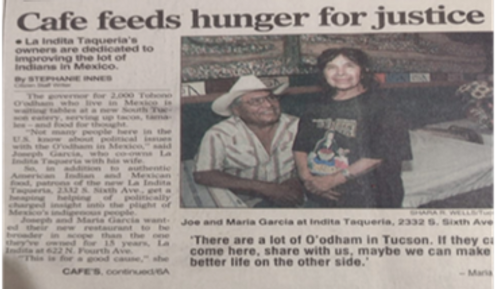
An exerpt from an old newspaper article featuring how Cafe La Indita [before it became today's restaurant] helped feed the Garcías' hunger for improving the lives of the O'odham in Mexico. Shared with Natasha Cortinovis by the Garcías
As the air cools down with the sun gone, Maghi the watchdog is still resting beneath the coat-of-arms of the indigenous school. Fellow prisoner of Northern Mexico’s splendor and travail, she’s unaware of the García family’s decades’ long luchas for the wellbeing of the native peoples of Sonora that led to the property she now devotedly guards.
“I didn’t want the O’odham and other indigenous people to lose their identity,” says Maria Angelita García, who first chose to dedicate the property at the top of camino a Tubutama, San Isidro [Sonora, Mexico], to indigenous and alternative medicine practices under the name of Clínica La Joya, hosting trainings on acupuncture, magnetotherapy, mud therapy, medicinal desert plants, and healthy nutrition.
“It was an indigenous health and wellness clinic before, with some rooms under construction probably intended for patients’ examination,” says Coleman Smith, 74, who’s been involved on the property as architect, engineer and project manager for the past three years. “The García family, with José García Lewis being the leader of the O’odham in Mexico, has been working fiercely over the years to fight against the erasure of their people,” he adds, while Maghi begs him for caresses.
Among their achievements is the recognition of Sonora’s indigenous peoples’ rights in Mexico’s voting code, in articles 1 of the Constitution of Sonora and 4 of the constitution of Mexico, including the official recognition of the figure of the indigenous councilor in each of the 19 municipalities where the ethnic groups of Sonora exist. In 1995, the Tohono O’odham Nation of Arizona also recognized the figure of the traditional O’odham leader to support their people in Mexico with as many resources as they can possibly provide despite the laws and regulations of crossing an international border, says the Chairman Verlon Jose.
It is in honor of García Lewis’ mother, who was “a loving lady with a smile of hope to see the indigenous struggles come to victory against the injustices of lands’ dispossessions that the Tohono O'odham people have suffered,” that Clínica La Joya was later transformed into the non-profit Fundación Elena Teresa Lewis to cherish indigenous cultural roots.
“Why don't we create a school to honor the culture, customs, and language of the O'odham,” proposed Denise Ixchel Schafer to her parents during a 2020 visit to Magdalena de Kino, SON. “We need to teach the O’odham language, because without the language the culture dies. There are only five people who can still speak O’odham in Mexico.”
Tohono O’odham basket weaver, potter, and paper-maker Reuben Naranjo, 61, also says that “there's less than ten speakers of O’odham left in Sonora.”
That’s how now, Maghi’s tail wiggles enthusiastically on the Escuela Himdag Ki: Tohono O’odham Mexico.
At golden hour, Architect Coleman Smith passionately presents the school’s projects and infrastructural advancements. Video by Natasha Cortinovis
The first school’s purpose is to teach several O’odham language classes for the culture to live on also through the world of words. A young gentleman from Caborca, SON., is currently teaching the language online through Zoom, but the hope is to expand the instruction not only of O’odham, but also of Spanish and English.
“We also need to teach the poorer people English for them to be able to discuss daily matters with those from the other side, especially here in the borderlands,” says Schafer, now the school's director. “It could open so many doors for them.”
Within Spanish or English, a Chicano writer for five U.S. Latino newspapers, activist for U.S.-bound migrant rights, and public figure Magdaleno Rose-Avila offers to hold seminars on public presentation skills and poetry writing.
“We all have ideas, and I would like the people to be able to fight for their cause by learning how to express what they have inside,” he says. “The public presentation classes I took at the University helped me a lot in the fight for my people's rights during the Chicano movement.”
Apart from imparting language instruction benefitting Northern Mexico’s indigenous groups, the Garcías believe it is also just as essential to maintain the indigenous culture alive in the present and long into the future.
“With sodas, Pepsi Colas, chips, Walmarts, air conditioning… we’re losing the indigenous ancestral culture,” says Schafer.
In this fight against obliteration, the O’odham school Himdag Ki intends to offer workshops on the tribes’ tradition of basket and jewelry making, pottery, desert plants and foods identification, desert survival skills, and history.
In honor of the archeological and anthropological wealth of Sonora’s border areas, the school is already a field trip’s destination for groups of College students pursuing border and Native-American studies’ degrees.
“Although it was conceived as a clinic, this place has a lot more to offer as a cultural community center that teaches, practices, and shares,” says architect Smith. “And we are on our way to provide a clean, safe, and welcoming space for people to be,” he adds, pointing at some of the buildings under construction.
Architect Coleman Smith explains that the school was a wellness clinic before, and then gets interrupted by Maghi the watchdoggo after she wakes up from a nap. Because of her affection, he shares more about Maghi's story. In the backdrop are some of the school’s buildings under construction. By Natasha Cortinovis
Just like it opened its doors to a once starved stray dog, the school wants to welcome all, soon offering also overnight accommodation.
“The eight indigenous tribes of Sonora are related here,” says Smith, opening his arms towards the Sonoran Desert surrounding the property. “Although this project was initiated by the O’odham, it's open to all who want to partake.”
The Garcías insist on this inclusive nature of the school Himdag Ki:. Soon, they will be visiting the homelands of every one of the eight tribes of Sonora to engage their artists in painting a mural of their identity on eight of the school’s windows.
“We don’t want anybody to feel left out,” says Schafer vehemently, picturing a colorful school that represents every tribe of the State.
Inside the classroom, photographs of María and José García’s endeavors in the fight for their peoples’ rights hang on the white walls. Further down the hall, a white board hosts in a neat handwriting a bullet point list of all the school’s plans.
“It’s going to be a tremendous place,” says Rose-Avila.